
This write-up primarily deals with the law relating to sealing and de-sealing of immovable properties within the National Capital Territory (NCT) of Delhi. The relevant provisions are contained mainly in the Delhi Municipal Corporation Act, 1957, the Delhi Development Act, 1957, the New Delhi Municipal Council Act, 1994, and the Master Plan for Delhi (MPD). While the statutory framework is specific to Delhi, the legal principles governing sealing and de-sealing of properties — such as the nature of sealing (a regulatory restraint, not confiscation), the competence of municipal/development authorities to effect sealing, and the requirement of due process before permanent de-sealing — remain broadly similar across municipal and urban development laws in different States and Union Territories in India.
Meaning of Sealing and De-Sealing
What is Sealing of Property?
Sealing of immovable property generally refers to an administrative or regulatory action by a government or municipal authority whereby access to, and use of, a building or part of a building is legally restricted by physically “sealing” it (often by locking, welding, or affixing official seals on doors, shutters, or entrances).
It is not a confiscation; ownership is not taken away. The property still belongs to the owner, but use and occupation become prohibited.
What is De-Sealing of Property?
Technically, “de-sealing” is nothing but the reversal of the sealing action. It restores the pre-sealing situation.
When is sealing done?
Authorities typically seal an immovable property in cases such as:
- Misuse of property – e.g., using residential premises for commercial purposes without permission (common under Delhi Master Plan / DMC Act).
- Unauthorized construction – e.g., additional floors, basements, or alterations made without sanction.
- Violation of land use – e.g., using agricultural land for industrial purposes.
- Non-compliance with orders – where demolition/removal notices are ignored.
Who has the power to effect the Sealing of property?
The following Authorities can do the sealing:
- Hon’ble Supreme Court Appointed Monitoring Committee vide Judgement dated 16th Feb 2006 in M. C. Mehta vs UOI & Ors Writ Petition (civil) 4677 of 1985 (I.A. No. 22)
- Municipal Corporation of Delhi under Section 345A of the DMC Act 1957
- Delhi Development Authority under DDA Act read with MPD 2021
- New Delhi Municial Council under NDMC Act 1994
- Pollution Control Boards (CPCB/SPCBs): Power to seal/close polluting industrial units under the Air & Water Acts.
- Excise/Customs/GST Authorities: Can seal warehouses, godowns, or business premises during proceedings.
- Electricity Distribution Authorities: Can seal meters/premises for theft or misuse.
Sealing and De-Sealing by Monitoring Committee (MC)
What is the Monitoring Committee?
In the context of the Judgement dated 16 Feb 2006, M.C. Mehta v. Union of India, Writ Petition (civil) 4677 of 1985 (I.A. No. 22), the Monitoring Committee was a body appointed by the Supreme Court to oversee and ensure implementation of its sealing orders against misuse of residential premises for commercial purposes in Delhi.
The Committee’s appointment was a judicial mechanism to enforce fundamental rights and rule of law, since statutory authorities (MCD/DDA) had failed to check large-scale misuse.
What are the grounds for Sealing by the Monitoring Committee?
Misuse of Residential Premises for Commercial Purposes
- Large-scale conversion of residential houses into shops, showrooms, offices, coaching institutes, etc., in violation of the Delhi Master Plan.
- The court clarified that small shops for day-to-day needs were not under consideration — only blatant, large-scale misuse.
Restriction on the power of the Monitoring Committee
While dismissing the review petition for the August 14, 2020 judgment (M.C. Mehta case), the Supreme Court reaffirmed its August 14, 2020 judgment (M.C. Mehta case), which had ruled that the Monitoring Committee cannot enforce sealing against purely residential premises that are not misused commercially. Any such overreach is beyond its mandate.
Sealing and De-Sealing by MCD under the DMC Act 1957
The Delhi Municipal Corporation Act 1957 (DMC Act 1957)
The powers relating to both sealing and de-sealing of property flow to the Commissioner, MCD, under Section 345A of the DMC Act, 1957. These powers are further delegated to the Deputy Commissioner, MCD, by virtue of Section 491 of the said Act.
Unified Building Bye Laws 2016 (UBBL 2016)
Under chapter 2, heading 2.9.2 of the UBBL 2016, it is provided that In case of unauthorized development, beyond the permissible/ compoundable limits of these bye-laws (as specified in Annexure IV of the UBBL 2016) and provisions of MPD, the sanctioning authority shall take suitable action, which may include demolition of unauthorized works, sealing of premises, prosecution and criminal proceeding against the offender in pursuance of relevant laws in force. The demolition shall be at the risk and cost of the owner.
Sealing as provided u/s 345A of the DMC Act 1957
Sealing of the property can be ordered by the Commissioner or Deputy Commissioner (Through Delegated Power u/s 491 of DMC Act 1957)
- Before or after making an order of demolition under section 343 or
- Before or after of the stoppage of the erection of any building or execution of any work under section 343 or under section 344
Sealing can be ordered for
- Above Erection or
- Above Work or
- Above premises in which such erection or work is being carried on or has been completed in the manner prescribed by rules
Sealing can be done to
- Carry out the provisions of DMC Act 1957, or
- Prevent any dispute as to the nature and extent of such erection or work.
Removal of Seal (De-Sealing) as provided u/s 345A of the DMC Act 1957
Section 345A(2) states that the Commissioner may order for removal of the seal for the purpose of demolishing any erection or work, due to which the sealing order was passed, in accordance with the provisions of this Act. Section 345A(3) further states that a person’s Seal can be removed only in the following two circumstances, viz.,
- In accordance with an order made by the Commissioner u/s 345A(2) as above or
- In accordance with an order passed by an Appellate Tribunal or the Administrator in an appeal made under this Act.
In the DMC Act 1957, the term “Administrator” is defined in Section 2(1A), which means the Lieutenant Governor of the National Capital Territory of Delhi.
Temporary De-Sealing vs Permanent De-Sealing #PointOfView
View 1
A plain reading of Sections 345A(2) and 345A(3) of the DMC Act may lead one to conclude that the Commissioner or Deputy Commissioner is empowered only to order temporary de-sealing, for limited purposes such as enabling removal of unauthorized activity, clearing furniture, or carrying out demolition. On this interpretation, the power to order permanent de-sealing would rest exclusively with the Appellate Tribunal or the Administrator (Lt. Governor) in appeal, unless the High Court intervenes and directs de-sealing on broader grounds such as natural justice, interim relief, or jurisdictional error.
View 2
Conversely, the contrarian — and, in fact, the correct — view is that it is now well established that the Commissioner or Deputy Commissioner may also order permanent de-sealing once the misuse or unauthorized construction that formed the basis of sealing has been duly removed. This view is anchored in the principle that when the very cause of action ceases to exist, the sealing order cannot be sustained and loses its legal foundation. The underlying reasoning is that:
- A sealing order is not punitive in perpetuity but remedial, meant to curb ongoing illegality.
- Once the cause (misuse/illegal construction) is removed, the order cannot survive.
- Continuing sealing despite compliance would be arbitrary and ultra vires Article 14.
On this reasoning & interpretation, Commissioner/DC is seen as competent to order permanent de-sealing upon verification that misuse has ceased.
MCD’s Delegation of authority to De-Seal
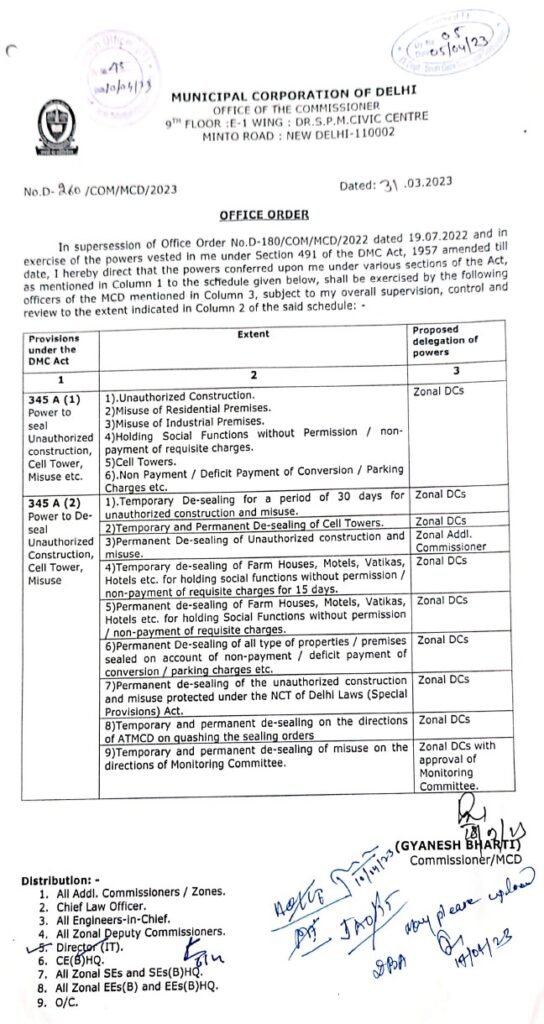
Section 345A
345A. Power to seal unauthorised constructions

(1) It shall be lawful for the Commissioner, at any time, before or after making an order of demolition under section 343 or of the stoppage of the erection of any building or execution of any work under section 343 or under section 344, to make an order directing the sealing of such erection or work or of the premises in which such erection or work is being carried on or has been completed in the manner prescribed by rules, for the purpose of carrying out the provisions of this Act, or for preventing any dispute as to the nature and extent of such erection or work.

(2) Where any erection or work or any premises in which any erection or work is being carried on, has or have been sealed, the Commissioner may, for the purpose of demolishing such erection or work in accordance with the provisions of this Act, order such seal to be removed.

(3) No person shall remove such seal except—
(a) under an order made by the Commissioner under sub-section (2); or
(b) under an order of an Appellate Tribunal or the Administrator, made in an appeal under this Act.